Things You Should Know About Lead in Drinking Water
Important Information About Lead
Lead is a common, naturally occurring metal that is found throughout the environment in lead-based paint, air, soil, household dust and occasionally water. Lead can pose a significant risk to your health if too much enters your body. If present, elevated levels of lead can cause serious health problems, especially for pregnant women and young children. Oshkosh’s drinking water is safe to drink and meets or exceeds all drinking water regulations. Lead is not found in Oshkosh’s source water, Lake Winnebago, and is not in water as it leaves the drinking water treatment plant. Lead may enter drinking water as a result of corrosion of lead piping, lead pipe solder, and household plumbing fixtures containing lead. Oshkosh adds a phosphate compound, which meets the Environmental Protection Agency's (EPA) standards for safety, to coat water pipes and prevent leaching of lead into drinking water and which is successful in reducing lead levels. Oshkosh water samples from customer taps are below the regulated action level of 15 parts per billion.
Constant exposure of water to lead in plumbing can cause lead to become dissolved in the water. This occurs when water sits in a pipe too long. If water has been sitting for several hours, you can minimize the potential for lead exposure by flushing your tap for 2 minutes before using water for drinking or cooking. If you are concerned about lead in your water, you may wish to have your water tested. Information on lead in drinking water, testing methods and steps you can take to minimize exposure is available from the Safe Drinking Water Hotline at (800) 426-4791 or from the USEPA's informational website(external)
How Lead Enters Our Water
Lead in drinking water, although rarely the sole cause of lead poisoning, can increase a person's total lead exposure, particularly the exposure of infants who drink baby formula and concentrated juices that are mixed with water. The EPA estimates that drinking water can make up to 20% of a person's total exposure to lead.
Lead Service Map
City water mains are not made of lead. Water service lines (the small pipe between a water main and a home) are partially owned by the City and partially owned by the property owner. Water service lines may be made of lead.
City, or public, service line – the pipeline between the water main and the curb stop.
Homeowner, or private, service line – the pipeline between the curb stop and the water meter.
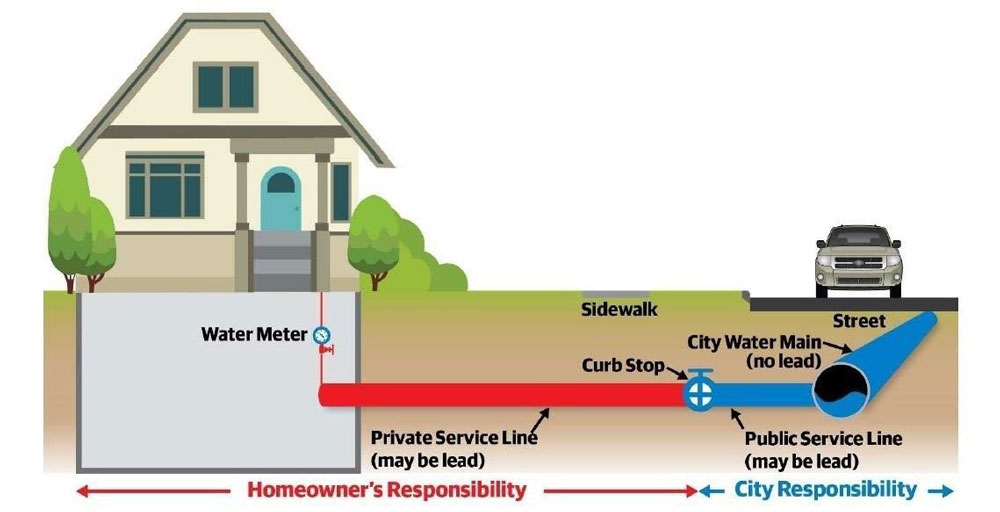
There are an estimated 7,500 – 9,700 public lead service lines and an estimated 11,000 private lead service lines. The lead service map shows only the services which are lead on the City, or public, portion of the service line.
How To Check if Your Service Line is Made of Lead
Homeowners' water service lines may be made of lead, copper, galvanized steel, or plastic.
To check if your service line is made of lead, follow these steps:
You will need:
- Key or a coin
- Strong refrigerator magnet
- Find the water meter in your basement. Look at the pipe that comes through the outside wall of your house and connects to your meter.
- Carefully scratch the pipe (like you would a lottery ticket) with a key or a coin. Do not use a knife or other sharp tool. Take care not to make a hole in the pipe. If the scratch turns a shiny silver color, it could be lead or steel.
- Place the magnet on the pipe. If the magnet sticks, it is steel pipe.
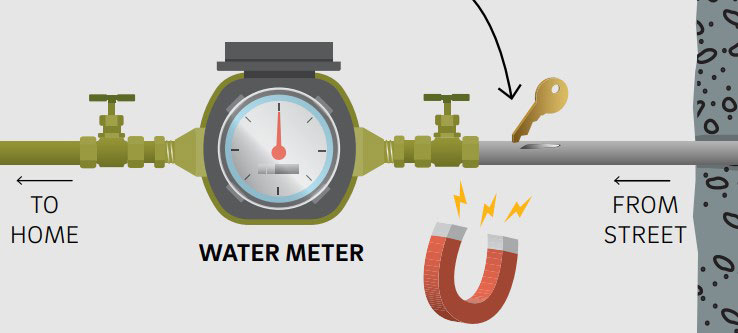
Lead is dull, very soft and will turn a shiny silver color when scratched.
Magnets will ONLY stick to steel. They will NOT stick to lead or copper.
A licensed and insured plumber can also inspect your pipes and other plumbing for lead.
Things You Can Do To Reduce Lead in Your Drinking Water
Take these steps to reduce exposure to lead in water if you have a lead service line:
Flush your plumbing
Before using tap water for drinking or cooking, run the cold water until it is noticeably colder. Do this if the water has been standing unused in your pipes for more than 6 hours, such as overnight. Tap water can safely be used for activities such as bathing, washing hands, washing dishes, and laundry. These activities help flush the pipes.
Drink and cook only with water from the cold tap
Never drink or cook with water from the hot water tap. Hot water dissolves lead from pipes. Boiling the water does not remove lead. Households with children and pregnant women should consider using bottled water or filtered tap water for formula, concentrated juices, cooking and drinking.
Regularly remove the screen and aerator from faucets, rinse out any particles, and re-attach.
Particles may contain lead and could collect at the faucet. Clean faucet aerators once a month, or more frequently if there is water utility construction work nearby. Clean aerators after any household plumbing work is completed.
Other steps you may consider:
Purchase a home filtration system
Drinking water filtration systems or pour-through filters can reduce or eliminate lead. Look for products certified by NSF/ANSI under Standard 53 for removal of lead and follow the manufacturer's guidelines for installing and maintaining the filter.
Replace your lead service line or interior plumbing
A licensed plumber can provide an estimate. If you decide to do this, please call the Public Works Management Analyst at 920-236-5258, for more information.
Have your water tested for lead
Find a laboratory where you can have your water tested for lead or call the Water Filtration Plant Manager at 920-236-5164. Wisconsin laboratories, including those listed below, can provide lead testing.
- Northern Lake Service, Inc. at 715-478-2777
- Badger Laboratories & Engineering Company, Inc. at 920-729-1100
- Eurofins S-F Analytical Laboratories Inc. at 262-754-5300
- Davy Laboratories at 608-782-3130
- TG Analytical Laboratories at 920-757-1355
Flush your plumbing after any water utility work or internal plumbing work
Physical disturbance of the lead service line or lead plumbing by activities such as water main replacement, service line leaks, home plumbing repair, water meter replacement, or main breaks may release lead into the water.
Here's how to flush your household plumbing after work is completed:
- Remove screens and aerators from the end of all faucets and rinse particles from them.
- Starting in the lowest level (basement) and working to the top floor, turn on the cold water.
- After the water runs for 5-10 minutes, start at the top floor and turn off the water, finishing in the basement. Re-attach the screens and aerators to the faucets.
Replacing Lead Service Lines
Since 2011, Oshkosh has spent more than millions of dollars replacing thousands of public lead service lines. Oshkosh has operated a Lead Service Line Replacement (LSLR) Program since 2017 with the goal of fully replacing lead service lines in the City. These efforts will take several years and cost tens of millions of dollars. Complete lead service line replacements are planned as follows:
- Infrastructure coordination - Where possible, our lead service line replacement program follows planned street, sewer, and other infrastructure improvement projects. This decreases situations where the same street is opened up more than once for improvement projects.
- Complete partial service line replacements – replace the private portion of service lines where the public portion has already been replaced.
EPA's Lead Regulation
The EPA sets upper limits or maximum contaminant levels (MCLs) for most substances it regulates in a utility's drinking water system. These MCLs are set at levels designed to protect the health of customers. For most contaminants, testing takes place at the utility's treatment plant or in its distribution system. Lead is different, because it's not commonly found in a water utility's source water or its distribution system. Usually, lead dissolves into drinking water after the water has entered the customer’s property. For lead, EPA has set an action level designed to measure a utility's effectiveness in controlling the corrosiveness of drinking water so that lead doesn't easily dissolve into it. For lead, EPA requires that samples be taken from faucets inside the homes of a certain number of customers. These tests must be taken in homes likely to have the highest concentration of lead. That includes houses with lead service lines and houses with copper plumbing built just before lead-based solder was outlawed in the late 1980s. EPA's action level for lead is 15 parts per billion at the 90th percentile. That means 90 percent of the homes sampled for lead have to have a lead concentration of 15 parts per billion or less. Utilities that exceed the action level need to do more to reduce the corrosiveness of their drinking water, increase their public information campaign, and begin removing lead service lines, if they have any. Oshkosh Water Utility completes the required sampling and sample results comply with all drinking water regulations. Learn more about water provided by the Water Utility by reviewing the most recent Consumer Confidence Water Report, found on the City's Water Utility page.
If you have questions about lead in drinking water, call the Public Works Management Analyst at 920-236-5258.