Wastewater Treatment Plant
Tertiary Filtration and UV Disinfection Upgrades
Overview of Project
The City of Oshkosh is upgrading its Wastewater Treatment Plant to improve treatment performance, operational safety, and readiness for future regulatory and capacity needs.
The project will install a tertiary cloth media disc filtration system and replace the existing chlorine disinfection system with ultraviolet (UV) light disinfection. These improvements will support cleaner treated-water discharge to the Fox River and Lake Winnebago watershed and help the City meet total maximum daily load requirements and permit discharge limits.
Major components include UV equipment designed for peak flows of up to 120 million gallons per day, a new building above the existing contact chambers, effluent pumping and electrical upgrades, and a sodium hypochlorite system for residual disinfection.
The estimated project cost is $34 million, funded through the Wisconsin Clean Water Fund Program.
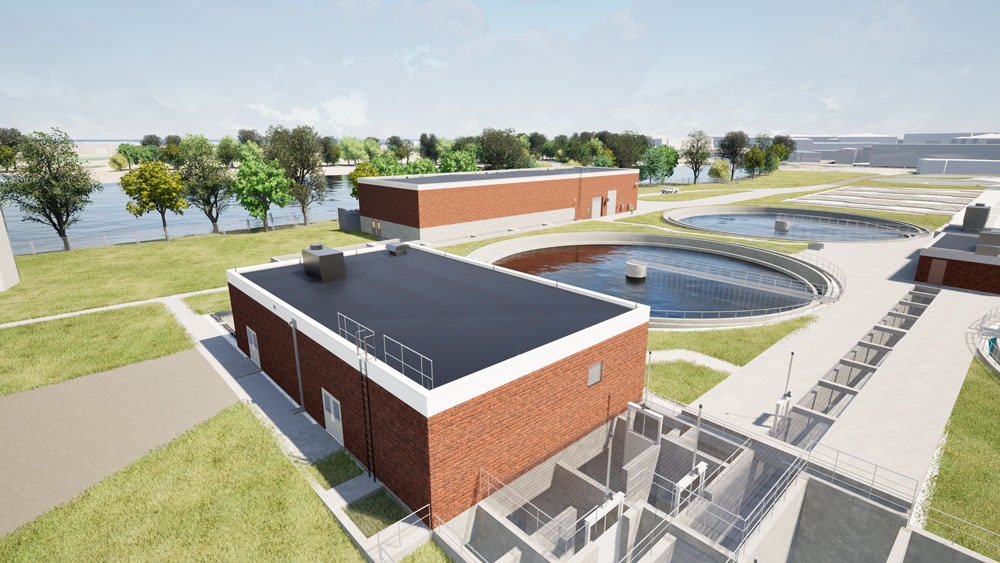
Rendering of the completed UV Disinfection Building (foreground) and Filtration Building (background).
Current Status
- Design and bidding of the project are complete.
- The contractor awarded the project is Miron Construction.
- Construction of the project has started.
Why Are We Doing This?
The project will:
- Improve wastewater treatment performance and support cleaner discharge to the Fox River and Lake Winnebago watershed.
- Help the City meet current and future total maximum daily load and permit discharge limits.
- Increase the plant's ability to manage future treatment and capacity needs.
- Improve employee and operational safety by eliminating chlorine gas handling.
- Reduce operations and maintenance costs and simplify plant operations.
- Modernize treatment, pumping, and electrical infrastructure.
Key Terms Used on This Page
Tertiary treatment
An advanced stage of wastewater treatment that further removes contaminants after primary and secondary treatment.
Cloth media disc filtration
A filtration process that uses cloth-covered discs to remove fine particles from treated wastewater.
UV disinfection
A process that uses ultraviolet light to inactivate microorganisms in treated wastewater.
Effluent
Treated wastewater released from a treatment plant.
Total Maximum Daily Load (TMDL)
A water-quality planning tool that establishes the maximum amount of a pollutant a waterbody can receive while still meeting water-quality standards.
Residual disinfection
Disinfection of the plant effluent water that is recycled and used internally at the facility.
Sodium hypochlorite
A liquid disinfectant used in wastewater treatment, commonly known as bleach.
FAQs
Why is the City replacing chlorine disinfection with UV disinfection?
UV disinfection eliminates chlorine gas from the site, which improves staff and community safety, reduces operations and maintenance costs, simplifies plant operations, and works efficiently with the new tertiary filtration system.
Will the project improve local water quality?
Yes. The filtration and UV disinfection upgrades will support cleaner treated-water discharge to the Fox River and Lake Winnebago watershed.
How much will the project cost?
The project is estimated at $34 million.
How is the project funded?
The project is funded through the Wisconsin Clean Water Fund Program.
When will construction be complete?
Work is expected to be complete by December 2027